Category: Uncategorized

  • True Faith Can Soften the Heart

    There is a quiet strength in true faith. It does not shout, force, or demand. Instead, it works gently—like rain on dry ground—softening what has become hard, tenderizing what has been wounded, and awakening what once felt numb.

    Life has a way of hardening the heart. Disappointments pile up. Betrayals leave scars. Prayers seem unanswered. Over time, we build walls—not because we are cruel, but because we are tired. We learn to protect ourselves. We learn to close off. And without realizing it, the heart that once trusted freely becomes guarded and heavy.

    This is where true faith enters—not as a rulebook, but as a healing presence.

    True faith teaches us to trust again, not in our own strength, but in God’s faithfulness. It reminds us that even when people fail us, God remains constant. Faith does not deny pain; it carries pain into God’s hands. And in that surrender, something remarkable happens—the tight grip of bitterness loosens, and the heart begins to breathe again.

    A softened heart is not a weak heart. It is a brave one. It takes courage to forgive when wounds are still fresh. It takes faith to remain kind in a world that often rewards hardness. True faith reshapes our inner posture, turning clenched fists into open palms. It allows compassion to flow where resentment once lived.

    When faith is real, it humbles us. We realize we are not self-made, not self-sustaining. We become more patient with others because we recognize how patient God has been with us. We listen more. We judge less. We love deeper. Faith gently removes the rough edges of pride and replaces them with understanding.

    Scripture captures this transformation beautifully:

    “I will give you a new heart and put a new spirit within you; I will remove from you your heart of stone and give you a heart of flesh.” (Ezekiel 36:26)

    A heart of flesh feels. It hopes. It believes again. It weeps, but it also rejoices. True faith does not make us immune to suffering—it makes us responsive to grace. It teaches us that softness is not surrender to the world, but surrender to God.

    In a time when being hard seems necessary for survival, true faith invites us to be tender instead. And in that tenderness, we discover strength—the kind that heals, restores, and reflects the very heart of God.

    May your faith continue to soften you—not into fear, but into love; not into passivity, but into compassion; not into fragility, but into a quiet, unshakable trust that God is still at work within you.

    “Faith is choosing to trust God’s light even when the road is dark, believing that every step you take in hope is already a step toward His promise.” ✨


    No comments on True Faith Can Soften the Heart

    Leave a Reply

    Your email address will not be published. Required fields are marked *

  • Repentance Is a Doorway

    Repentance is often misunderstood as a place of shame, but in truth, it is a doorway—wide open, filled with light, and marked by grace. It is not the end of the road; it is the beginning of a better one. When God invites us to repent, He is not pushing us away—He is calling us closer.
    A doorway exists for one purpose: to lead us from where we are into somewhere new. Repentance works the same way. It gently asks us to pause, to turn, and to step forward with honesty. It does not deny our past, but it refuses to let our past define our future. Through repentance, the once heavy heart begins to breathe again.
    True repentance is not about fear of punishment; it is about the courage to change. It is the moment we lay down our pride and admit our need for God. In that surrender, something powerful happens: the hard heart softens, the wounded spirit finds healing, and the weary soul discovers rest. What once felt like failure becomes fertile ground for transformation.
    God does not stand on the other side of the doorway with crossed arms. He stands there with open hands. Repentance is met not with condemnation, but with mercy. Scripture reminds us that God delights in restoring what was broken. When we turn toward Him, He runs toward us, ready to forgive, renew, and rebuild.
    Walking through the doorway of repentance changes how we see ourselves and others. We become more patient, more compassionate, more aware of grace—because we have tasted it ourselves. Repentance teaches us humility, and humility opens the heart to wisdom. It teaches us that growth is possible, no matter how far we have wandered.
    Every day, God places this doorway before us. It is not locked. It does not require perfection. It only asks for sincerity. One step of repentance can lead to freedom, peace, and a deeper relationship with God.
    So if your heart feels burdened, do not be afraid. Repentance is not a wall—it is a doorway. And on the other side is grace, restoration, and a new beginning waiting for you.

    Welcome to my website, which is full of inspiring, motivational, encouraging, and spiritual blogs for the betterment of humanity.

  • Understanding the Prostate Gland: Anatomy, Function, and Contemporary Research

    The prostate gland is a small yet pivotal component of the male reproductive system. Despite its modest size—about that of a walnut—it plays an essential role in fertility and male health throughout life. This review draws on current anatomical and physiological knowledge, supported by medical research, to provide a comprehensive understanding of this organ.

    Anatomy and Structural Overview

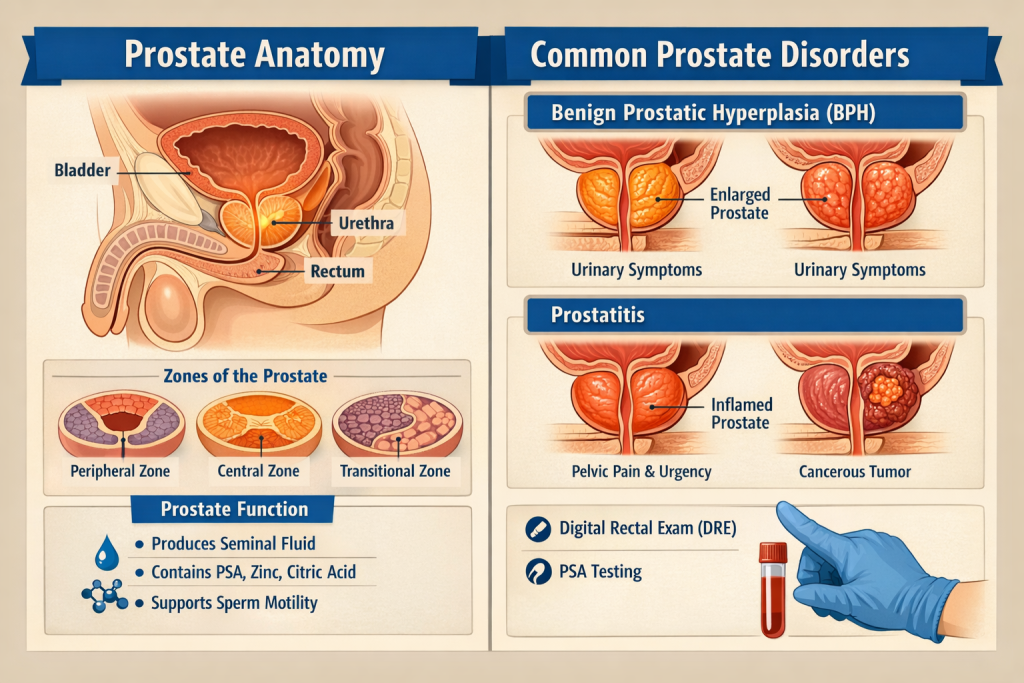
    The prostate is situated just below the urinary bladder and in front of the rectum, encircling the urethra—the tube responsible for carrying urine and semen out of the body. Its position means changes in prostate size or texture can impact urination and reproductive function.

    Anatomically, the gland is composed of both glandular tissue, which produces secretions, and fibromuscular stroma, which supports structural integrity and function. The prostate is classically divided into regions known as zones—peripheral, central, and transitional—each with distinct clinical relevance (e.g., cancer frequently arises in the peripheral zone).

    At the microscopic level, the prostate’s secretory units are tubuloalveolar glands, richly supplied with blood and surrounded by smooth muscle fibers. These muscles are critical for propelling prostatic fluid into the urethra during ejaculation.

    Physiology: What the Prostate Does

    The primary role of the prostate is to produce and secrete a significant portion of the fluid found in semen. This prostatic fluid is slightly alkaline and contains enzymes like prostate-specific antigen (PSA), fibrinolysin, citric acid, and various ions such as zinc, all of which contribute to sperm viability and mobility. The alkalinity helps counteract the acidic environment of the female reproductive tract, enhancing sperm survival after ejaculation.

    In addition to fluid production, the prostate contributes to:

    Sperm activation: Prostatic secretions help spermatozoa gain motility.

    Ejaculation mechanics: Smooth muscles in the prostate contract rhythmically during climax, aiding semen expulsion.

    Hormonal interactions: Androgens, especially testosterone and its more active derivative dihydrotestosterone (DHT), are critical for prostate development and secretory function.

    Clinical Importance and Common Conditions

    Because of its anatomical location, the prostate is implicated in several common health conditions:

    1. Benign Prostatic Hyperplasia (BPH)

    As men age, the prostate often enlarges, particularly within the transitional zone. This enlargement can compress the urethra, leading to urinary difficulties such as a weak stream, urgency, and incomplete bladder emptying. BPH is not cancer, but it can significantly impact quality of life.

    2. Prostatitis

    Inflammation of the prostate—often from bacterial infection or chronic inflammation—can result in pain, urinary symptoms, and discomfort during ejaculation. This condition can affect men of all ages, though it is especially common in younger and middle-aged adults.

    3. Prostate Cancer

    Prostate cancer is one of the most commonly diagnosed cancers in men globally and a major cause of cancer-related death. Tumors typically originate in the peripheral zone and may be detected via elevated PSA levels or digital rectal examination (DRE), with imaging and biopsy confirming the diagnosis.

    Current research continues to refine our understanding of prostate cancer biology. For example, scientists have identified proteins such as TBX-2 and LSD-1 that may contribute to drug resistance in aggressive prostate cancer forms, suggesting potential new therapeutic targets.

    Innovations in diagnostics are also emerging. Novel rapid blood tests using advanced imaging of dried blood smears have shown promise for early cancer detection, potentially enhancing screening accuracy beyond traditional PSA measurements.

    Hormonal Regulation and Development

    The prostate’s growth and function are intricately controlled by steroid hormones. Androgens such as testosterone and DHT are essential for prostate cell differentiation, growth, and secretory activity. Researchers emphasize the importance of cell-cell communication and androgen signaling in maintaining both normal prostate physiology and in the progression of pathological states.

    Conclusion

    The prostate gland, though small, is a complex and vital organ with roles that extend far beyond fluid production. Its intricate anatomy and physiology are foundational to male reproductive health. As research advances—from molecular studies of hormone regulation to groundbreaking diagnostic tools—our understanding of prostate function and disease continues to evolve, offering hope for improved prevention, diagnosis, and treatment of prostate conditions.

    👉 Recommended Resource:

  • Starting an Online Business with Purpose (Not Pressure)

    Starting an online business can feel overwhelming. There are countless promises, loud voices, and “get-rich-quick” claims that leave many people confused—or discouraged.

    I’ve learned that building something meaningful takes more than speed. It brings clarity, patience, and the right guidance.

    At Project Lovely, I believe business should be rooted in purpose. Growth is important, yes—but so is integrity. Not every opportunity is worth chasing, and not every tool is right for every person.

    For those who are beginning their online journey and looking for a structured way to understand how online business works, there are learning resources that focus on foundations rather than shortcuts. Programs that teach mindset, systems, and consistency tend to be more helpful than those that promise instant success.

    One resource I’ve personally explored is designed to help beginners understand the basics of online income, step by step. It emphasizes learning before earning, which aligns with my belief that good work takes time.

    👉 Recommended Resource:


    Disclosure: This post may contain affiliate links. If you choose to purchase through them, I may earn a commission at no additional cost to you.

    Read more: Starting an Online Business with Purpose (Not Pressure)

    Leave a Reply

    Your email address will not be published. Required fields are marked *

  • Forgiveness: A Sure Road to Peace Within Our Hearts

    Forgiveness is one of the most powerful gifts we can offer ourselves. It is not a sign of weakness, nor is it forgetting the hurt we have experienced. Instead, forgiveness is a courageous decision to set our hearts free from the weight that keeps us from moving forward. When we choose to forgive, we choose peace.
    Many times, the pain caused by others becomes a silent burden we carry every day. It affects our thoughts, our emotions, and even our dreams for the future. But the moment we decide to loosen our grip on anger and release the hurt, something beautiful begins to happen: our hearts become lighter, our minds clearer, and our spirits stronger.
    Forgiveness does not mean we approve of what happened—it simply means we are no longer willing to let the past control our present. It is choosing healing over bitterness, hope over resentment, and freedom over emotional chains. And the more we forgive, the more room we create for love, joy, and peace to enter our lives.
    True peace begins in the heart. When we let go of grudges, we open ourselves to God’s grace and allow His love to restore what was broken. Forgiveness becomes a pathway—one that leads not only to inner calm but also to a deeper connection with the people around us.
    Walk this road today. Let forgiveness be your quiet strength. Allow it to heal the wounds that once stole your joy. And as you forgive, may you discover the gentle peace that has always been waiting within your heart.
  • “Harmony in Wealth: Navigating the Spiritual Dimension of Money”

    Introduction:
    In a world often dominated by the pursuit of material wealth, it’s easy to overlook the profound connection between money and spirituality. Beyond the tangible transactions and financial strategies lies a deeper realm where the two seemingly disparate worlds intersect. Let’s embark on a journey to explore the harmonious relationship between money and spirituality, uncovering the transformative power of mindful wealth management.
    The Spiritual Essence of Money:
    Money, in its essence, is energy. It flows through our lives, impacting not only our material circumstances but also our emotional and spiritual well-being. Recognizing the spiritual dimension of money involves understanding the intentions and energy we invest in its acquisition and use. Are we driven by greed and attachment, or are we aligned with principles of abundance, gratitude, and generosity?
    Mindful Wealth Creation:
    Spirituality invites us to approach wealth creation with mindfulness. It’s not just about accumulating riches but also about understanding the impact of our financial decisions on ourselves and the world. By aligning our financial goals with our deeper values, we create a sense of purpose and fulfillment that goes beyond material success.
    The Art of Abundance:
    Spiritual teachings often emphasize the concept of abundance—the belief that there is more than enough for everyone. Shifting our mindset from scarcity to abundance opens the door to greater opportunities, creativity, and generosity. Embracing abundance doesn’t mean indulging in excess but rather appreciating the richness of life beyond monetary measures.
    Money as a Tool for Good:
    One of the most profound intersections of money and spirituality is the potential for positive change. Whether through philanthropy, impact investing, or conscious consumerism, individuals can use their financial resources to contribute to the betterment of society and the environment. This aligns with the spiritual principle that our actions should benefit not only ourselves but also the greater whole.
    Detoxifying Financial Stress:
    Financial stress is a common obstacle on the path to spiritual growth. By adopting mindful financial practices—budgeting, saving, and investing responsibly—we can alleviate the burden of money-related stress. This, in turn, frees up mental and emotional space for spiritual exploration and personal development.
    The Dance of Detachment:
    Spirituality teaches us the art of detachment—the ability to appreciate the impermanence of material possessions and outcomes. While financial success is a valid pursuit, it’s essential to detach our self-worth from our net worth. By doing so, we cultivate resilience and a deeper understanding of the transient nature of both wealth and life.
    Conclusion:
    Money and spirituality, far from being incompatible, can dance in harmony when approached with awareness and intention. By infusing our financial journey with spiritual principles, we not only enhance our material well-being but also embark on a path of personal and collective transformation. Let us strive for a balance that honors both the tangible and intangible aspects of wealth, creating a life rich in both abundance and spiritual fulfillment.
  • Hello world!

    Welcome to ProjLovely 🌱

    This is a space born from faith, hope, and the quiet belief that every life—every story—is still being lovingly shaped. Here, we celebrate growth in all its forms: personal, spiritual, and purposeful. Whether you arrived seeking inspiration, clarity for your journey, or encouragement for your work and dreams, you are not here by accident.

    ProjLovely exists to remind you that progress doesn’t have to be loud to be powerful. Patience matters. Humility strengthens. Faith anchors. Even in seasons of waiting, God is still at work—refining, restoring, and guiding each step.

    Take your time here. Reflect. Be inspired. Let your heart be encouraged to keep moving forward, one faithful step at a time.

    You are welcome. You are valued. And your journey is lovely in the making. ✨